

The conclusion first.
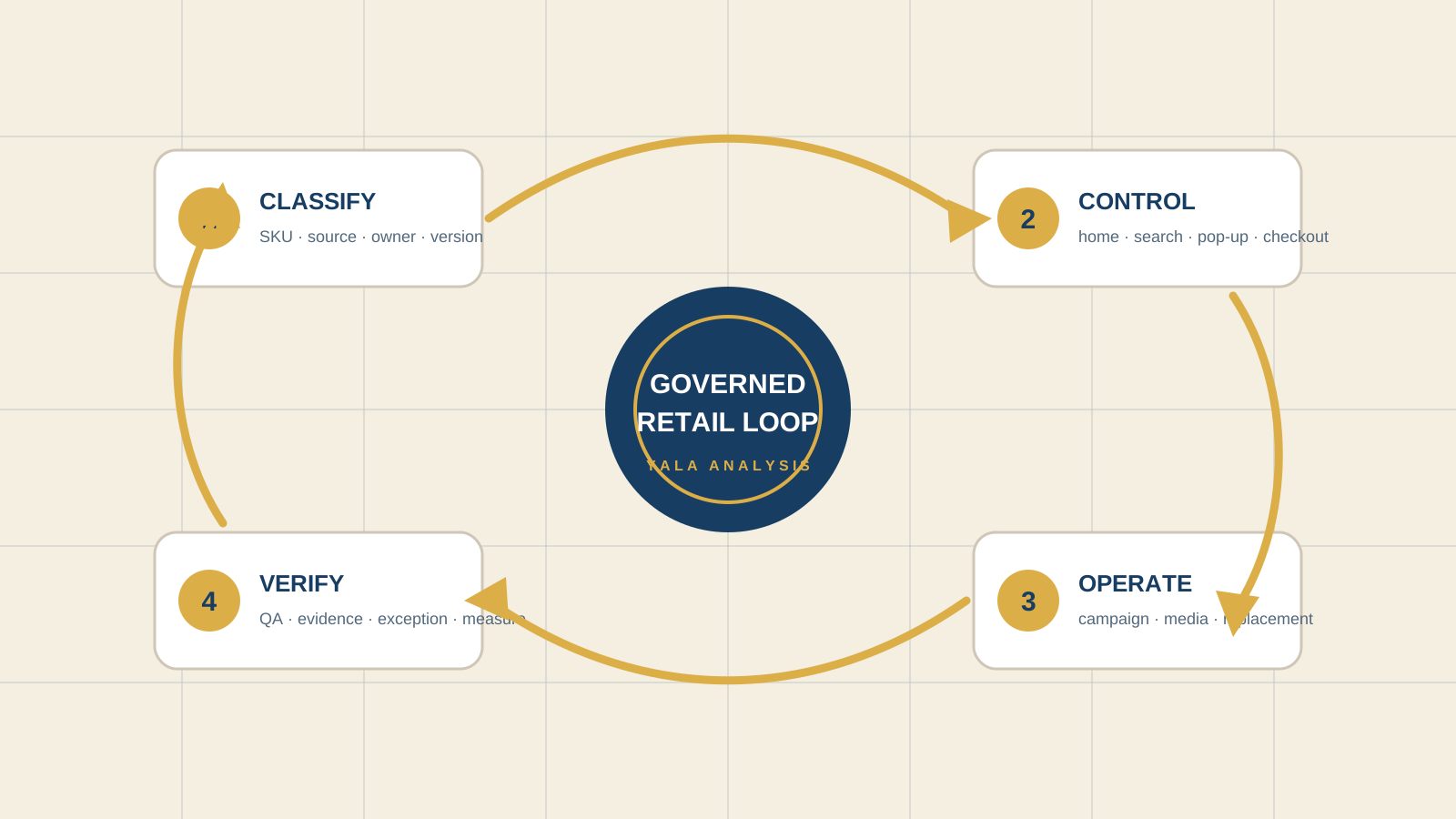
Abu Dhabi's new policy does not prohibit the sale of food and beverage products high in fat, salt and sugar. It limits whether products classified as unhealthy under SEHHI can occupy the most prominent physical and digital positions. From 1 January 2027, affected retailers cannot feature those products prominently on online supermarket homepages, search results, promotional pop-ups or checkout pages. The practical response is not a mass delisting exercise. Retailers need an auditable operating system that connects SKU classification, ranking rules, promotional inventory, brand agreements, interface controls and pre-release quality assurance.
- An online grocery interface is becoming a governed retail environment, not merely a neutral catalogue.
- The policy separates availability from high-exposure promotion; it should not be described as a sales ban.
- Retailers control interfaces and ranking, while food brands must manage classification evidence, portfolio choices and replacement promotions.
- The announcement does not publish every implementation detail, classification interface or online edge case, so companies still need regulator confirmation.
Early compliance is an operating capability, but the public evidence confirms store implementation only.
The official Abu Dhabi release identifies Carrefour as one of the first retailers to complete implementation and says the relevant placement standards were applied across its Abu Dhabi stores.
Policy can be translated into operating controls before the mandatory date.
Merchandising, product and review teams have to work as one system.
The public release does not disclose online changes, cost or sales impact.
What exactly changed?
The policy changes the allocation of high-exposure space, not whether a customer may buy a product.
Abu Dhabi Healthy Living and the Abu Dhabi Registration Authority announced the policy on 30 July 2026, with mandatory compliance from 1 January 2027. Food and beverage products classified as unhealthy under SEHHI may no longer occupy high-exposure positions such as store entrances, aisle ends and checkout areas, or be featured prominently on online supermarket homepages, search results, promotional pop-ups and checkout pages.
The official announcement says that products remain available for sale and may stay in normal aisles or purchase paths. For physical retail it identifies stores larger than 4,000 square feet. It does not publish every online boundary, technical interface, exception or enforcement procedure, so a press release alone is not a complete compliance manual.
What cannot be concluded from the announcement?
The distinction matters. An official announcement is a primary policy signal, but not a full implementation specification. A brand also cannot infer that lower prominence will automatically reduce sales, or that additional visibility for healthier products will guarantee conversion. Those effects require classification, implementation and controlled measurement.
| The public information confirms | It does not yet confirm |
|---|---|
| The policy covers named physical positions and four digital placements | How every recommendation component, organic ranking or personalised result will be treated |
| Mandatory compliance begins on 1 January 2027 | Every inspection frequency, penalty level or remediation window |
| Products remain available for sale | That any individual SKU is definitely in or out of scope |
| Carrefour completed the relevant standard across Abu Dhabi stores | What its online implementation involved or what commercial outcome followed |
Public case: what does Carrefour's early compliance show?
The official release names Carrefour as one of the first retailers to complete implementation and says the Responsible Food and Beverage Placement Standards have been applied across its stores in Abu Dhabi. The CEO of Majid Al Futtaim Holding confirms that status in the same government release.
The observable operating lesson is that a large retailer can translate policy into store merchandising, product-team routines and operating controls before the deadline. The public material does not separately document Carrefour's component-level online changes, testing method, cost or sales impact, so store completion should not be expanded into an omnichannel performance claim.
How can a retailer rebuild online operations?
01 Govern SKU classification
Connect product master data to the accountable SEHHI decision, source, version, owner and review date. Content teams should not guess classification.
02 Inventory high-exposure placements
List homepages, search results, promotional pop-ups, checkout and the recommendation, sponsored and manually curated modules that feed each position.
03 Separate availability from promotion
Preserve normal discovery and purchase while preventing restricted SKUs from entering prohibited prominent placements; log rule decisions and approved exceptions.
04 Build replacement pools
Prepare verified alternative SKUs, bundles and creative for every affected campaign so compliance does not create empty, repetitive or irrelevant recommendations.
05 Recalibrate brand and retail media
Update brand agreements, onsite media inventory, campaign calendars and creative approvals; do not assume a physical merchandising permission carries into digital.
06 Run pre- and post-launch QA
Test anonymous and signed-in states, languages, devices, cities and shopping stages. Preserve screenshots, rule versions, exceptions and remediation records.
Who owns what across the retailer, brand and advertising teams?
| Role | Core responsibility | Minimum validation |
|---|---|---|
| Retailer / platform | Product data, ranking, page modules, promotional inventory and audit records | Map restricted placements and run omnichannel regression tests |
| Food and beverage brand | Formulation, label evidence, SKU portfolio, promotions and alternatives | Provide verifiable classification inputs rather than self-declaring compliance |
| Retail media / advertising | Onsite inventory, sponsored search, audiences, creative and campaign approval | Separate regulatory scope from stricter internal brand-safety rules |
| Legal / compliance | Applicability, regulator questions, exceptions and evidence retention | Turn unresolved issues into written questions rather than operating assumptions |
| Data team | Exposure, search, add-to-cart, purchase and substitution measurement | Preserve a pre-change baseline and control for seasonality |
What should be measured beyond total sales?
The useful test is not simply total sales before and after the rule. It is a controlled comparison by placement, category and shopping task. Seasonality, price, promotion, inventory and traffic mix will move at the same time; without those controls, a team cannot attribute the outcome to the policy change or a specific interface decision.
- Coverage: are all restricted placements governed by an explicit rule?
- Exposure errors: can a restricted SKU still enter a prominent slot through cache, search, manual curation or personalisation?
- Replacement quality: do alternatives solve the same shopping task, rather than merely satisfy a category rule?
- Task completion: can customers still find the product they want and understand the alternatives?
- Commercial movement: track exposure, clicks, add-to-cart and purchase by category and placement without treating correlation as causation.
- Operating cost: is the time spent on classification, review, exceptions and brand coordination falling?
Separate fact, YALA analysis, hypothesis and forecast
| Status | Example | Boundary |
|---|---|---|
| Public fact | Policy date, named placements, compliance date and Carrefour store implementation status | Verifiable on official pages |
| YALA analysis | Classification, interfaces, media and QA should operate as one governed workflow | An operating method, not regulator wording |
| Working hypothesis | A better replacement pool may reduce experience and revenue loss | Requires platform testing |
| Forecast | More GCC retail regulation will address choice architecture in digital interfaces | A directional view, not an announced GCC-wide rule |
Further clarification.
Does the policy require HFSS products to be removed from sale?+
No. The official release says the products remain available; the change concerns prominent placement in specified locations. Individual classification still requires official criteria and regulator confirmation.
Can a brand comply by changing ad creative only?+
Not necessarily. Search ranking, pop-ups, checkout recommendations, sponsored placements, product data and campaign approvals can all influence exposure.
Does the Abu Dhabi policy automatically apply across the UAE or GCC?+
That cannot be assumed. This article covers Abu Dhabi's announcement; other emirates and GCC markets require separate regulatory verification.
What should a retailer do first?+
Assign SKU-classification accountability and map every high-exposure placement. Those two inventories define the downstream technical, content, commercial and QA workload.
Public sources used in this article
- YALA editorial illustration based on the public policy scopeYALA ANALYSIS · Accessed 2026-08-26 ↗
- سياسة العرض المسؤول للأغذية والمشروبات في السوبرماركت والمنصات الإلكترونيةالمكتب الإعلامي لحكومة أبوظبي · Accessed 2026-08-26 ↗
- SEHHI programmesAbu Dhabi Public Health Centre · Accessed 2026-08-26 ↗
- برنامج صحيمركز أبوظبي للصحة العامة · Accessed 2026-08-26 ↗
Sources support public facts, case imagery and methodological boundaries. YALA analysis, hypotheses and operating judgments are identified separately in the article.
YALA developed this research from public sources and its regional operating framework. AI assisted source organisation, structural checks and drafting; Jia Guo completed the final editorial review. To report a factual error or add evidence, contact hello@yalayala.ae.