

The conclusion first.
Arabic GEO is not sentence-by-sentence translation. A brand must keep its legal entity, brand name, products, service scope and material facts consistent across languages, while rebuilding headings, direct answers, explanation order, trust sources, internal links and action paths around the questions Arabic-speaking users actually ask. Literal translation can preserve wording yet miss Saudi and GCC context, Arabic intent, mixed-script brand queries and locally trusted evidence.
- Languages should share a governed fact base, not every sentence.
- Arabic question sets should begin with local tasks, not translated English keywords.
- Bilingual official pages, regulators and shareholder sources play different evidence roles.
- Language versions become testable only when separate URLs, reciprocal relationships and content quality work together.
One brand can share facts without sharing every sentence.
Riyadh Air's English and Arabic media hubs provide independent language paths around the same brand and announcement facts; PIF's portfolio page adds corporate identity and shareholder context.
English and Arabic pages have independently accessible paths.
Material announcement facts need to remain stable across languages.
Company and shareholder sources carry different proof responsibilities.
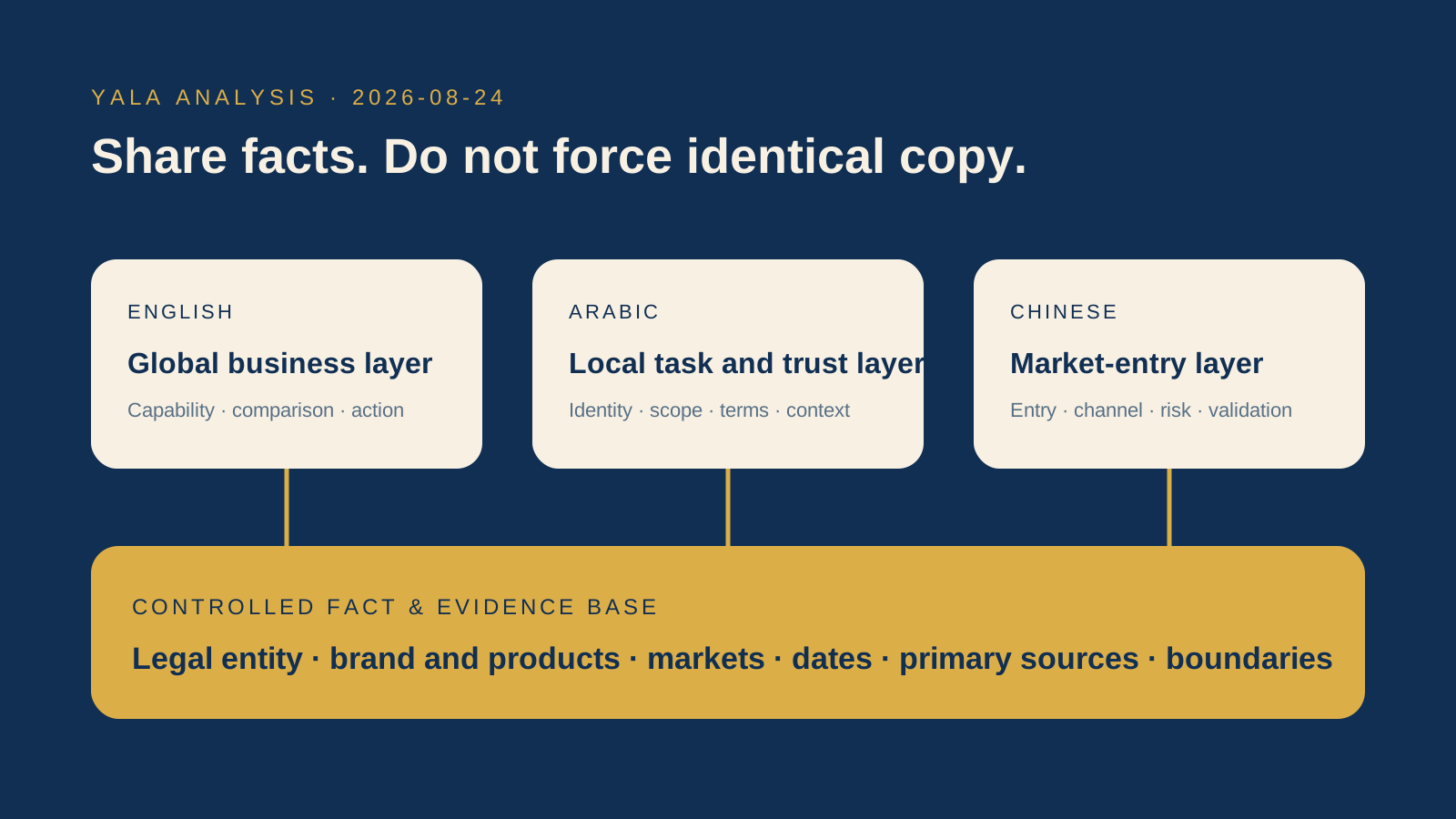
Why does literal translation create a GEO gap?
Different-language users may ask about the same entity without asking the same question.
An English business page may lead with group positioning, product capability and international partnerships. An Arabic reader may first need local service scope, official status, applicable cities, booking conditions, regulatory context or cultural relevance. The translated facts can be correct while the answer architecture remains misaligned with the task.
Answer systems also observe body copy, navigation, headings, links, outside mentions and cross-script aliases. Separating stable facts from language-specific expression prevents factual drift while allowing each language to complete its own answering job.
What must remain identical, and what should be authored again?
Google recommends separate URLs for language versions and hreflang to connect them. It also warns that automatic language redirects can prevent users and crawlers from reaching other versions. These technical relationships identify variants; they do not repair weak translation.
| Layer | Keep consistent | Re-author by language |
|---|---|---|
| Entity facts | Legal entity, brand, products, markets, address and dates | Order and explanation |
| Evidence | Primary sources, access dates and boundaries | Citation context |
| Questions | Shared business theme | Wording, intent and scenarios |
| Content | Meaning and limitations | Headline, examples, tone and action path |
| Technical | Canonical, hreflang, index and sitemap relationship | Readable URL and interface direction |
Public case: what does Riyadh Air's bilingual architecture show?
Riyadh Air maintains English and Arabic media hubs. Both describe the same brand, announcement dates, partnerships and route facts, but the headings, syntax and reading rhythm are not simple word-for-word mirrors. PIF's portfolio page adds shareholder-level facts such as establishment year, country and portfolio relationship.
This creates an observable evidence hierarchy: the airline site explains the brand and operating news, the Arabic pages organise those facts for local readers, and the PIF page supports corporate identity and ownership context. The lesson is not to copy Riyadh Air's copy, but to assign each source a clear proof role.
A practical GCC Arabic GEO workflow
01 Govern the fact base
Inventory entities, products, markets, licences, addresses, dates and sources, with a named owner.
02 Build separate question sets
Use Arabic customer service, sales, search, social and local media language rather than translating English keywords.
03 Author native answers
Write clear cross-GCC Modern Standard Arabic, then add Saudi, UAE or sector detail only where the business context differs.
04 Attach evidence
Return material claims to company, regulator, shareholder, platform or other primary sources and state what each proves.
05 Connect language versions
Use separate URLs, self-canonicals, reciprocal hreflang, visible switches and correct RTL behaviour.
06 Re-test fixed windows
Store full answers and citations by language, country, model, question and date; observe change without promising rank.
What should Arabic GEO measure?
Measurement should preserve the original question, model version, region, language, date, full answer and citations. One screenshot describes one sample. Without controls and a repeat window, a team cannot attribute a change to one article or technical edit.
| Metric | Question | It does not prove |
|---|---|---|
| Fact consistency | Are names, relationships, scope and dates aligned? | Guaranteed recommendation |
| Question coverage | Are local high-intent tasks answered? | Every GCC audience is covered |
| Source quality | Does the answer use primary or credible local sources? | Citations cause conversion |
| Language naturalness | Can business readers understand and act? | Machine translation equals localisation |
| Answer performance | How do presence, accuracy, citations and preference change? | Short-term movement is causal |
Keep facts, analysis, hypotheses and forecasts separate
| Status | Example | Boundary |
|---|---|---|
| Public fact | Riyadh Air has English and Arabic media hubs; PIF lists the portfolio relationship | Verifiable from official sources |
| YALA analysis | A shared fact base and native question layer should be governed separately | Method judgment, not a platform rule |
| Hypothesis | More natural Arabic answers may improve adoption stability in relevant questions | Requires a fixed question set |
| Forecast | GCC companies will bring language governance into brand-fact governance | Directional view, not completed fact |
Further clarification.
Can machine translation be used before human editing?+
It can assist the first draft, but a target-market editor must recheck intent, facts, terminology, tone and action paths. High-visibility brand content also needs GCC native business review.
Should Arabic only target Saudi Arabia?+
Not necessarily. A clear cross-GCC Modern Standard Arabic baseline can be maintained, with Saudi, UAE or sector pages added only where the business context truly differs.
Does hreflang increase AI citations?+
It helps search systems understand language relationships but does not guarantee AI citation or recommendation. Evidence, entity consistency, crawlability and repeatable testing remain separate workstreams.
Public sources used in this article
- Riyadh Air media hubRiyadh Air · Accessed 2026-08-24 ↗
- مركز طيران الرياض الإعلاميRiyadh Air · Accessed 2026-08-24 ↗
- Riyadh Air portfolio pagePublic Investment Fund · Accessed 2026-08-24 ↗
- Managing multi-regional and multilingual sitesGoogle Search Central · Accessed 2026-08-24 ↗
- Tell Google about localized versions of your pageGoogle Search Central · Accessed 2026-08-24 ↗
- Riyadh Air debuts second liveryRiyadh Air · Accessed 2026-08-24 ↗
Sources support public facts, case imagery and methodological boundaries. YALA analysis, hypotheses and operating judgments are identified separately in the article.
YALA developed this research from public sources and its regional operating framework. AI assisted source organisation, structural checks and drafting; Jia Guo completed the final editorial review. To report a factual error or add evidence, contact hello@yalayala.ae.