The conclusion first.
A brand should not choose the UAE or Saudi Arabia solely on population or market buzz. The first market depends on customer density, category fit, regulatory hurdles, channel cost, language and localisation needs, supply chain, collection cycle, team relationships and repeatability. A common working hypothesis is to use the UAE as a regional test and commercial hub, and Saudi Arabia as a scale market that needs deeper localisation. It is not a rule for every sector.
- Market size is not an entry order.
- Compare the verifiable requirements with the feasibility of delivery first.
- B2B, consumer goods and platform businesses have different answers.
- Identify the three roles of starting, validating, and expanding.
Entering new markets is not only gaining consumers, but also establishing local business conditions.
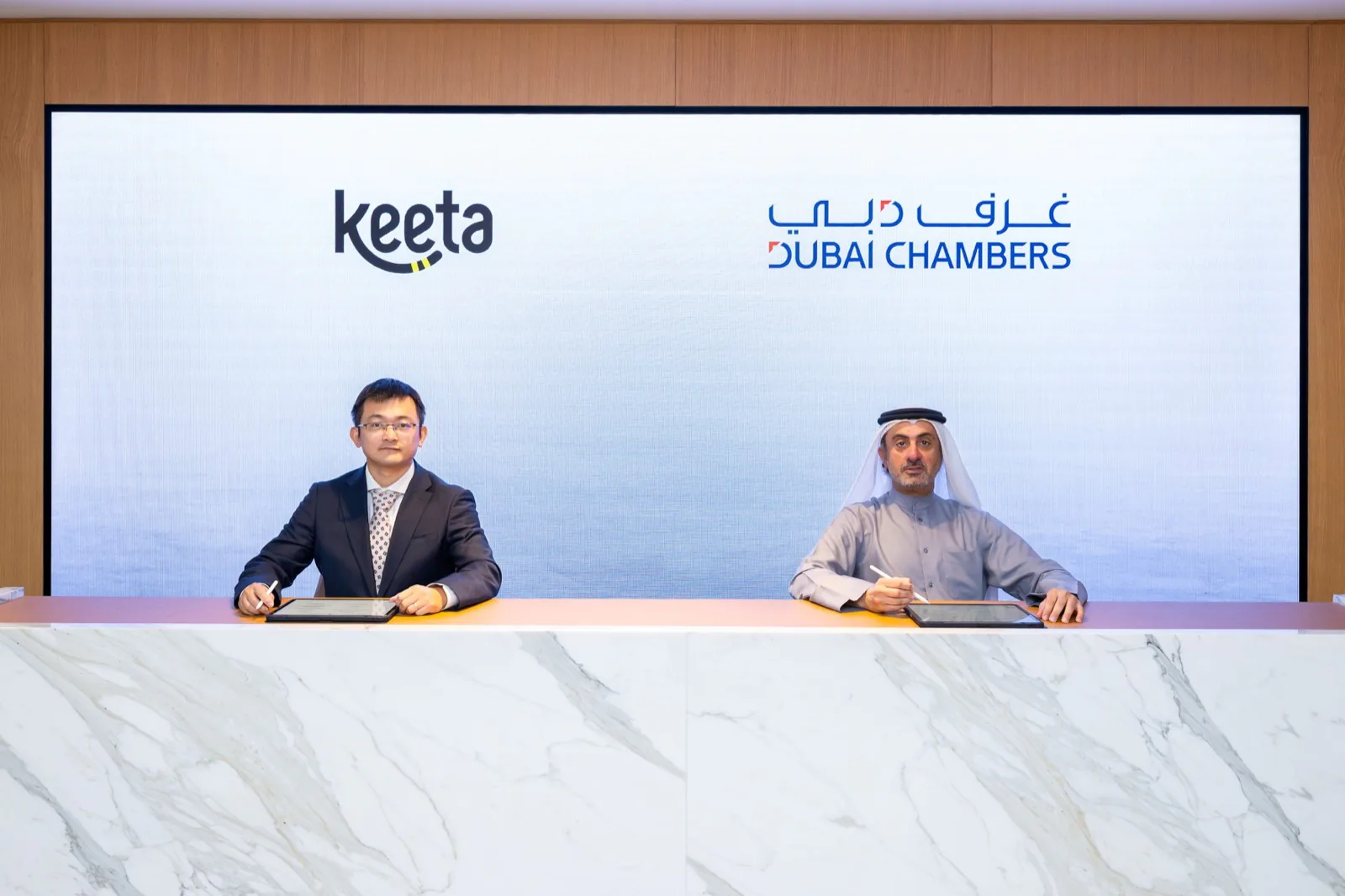
Collaboration information released by Dubai Chambers shows that Keeta's localization in Dubai also includes merchant ecology and SME market accessibility. This public action reminds the outbound team that consumer placement is only part of the path to entry, and that partner, regulatory, merchant supply, and fulfillment capabilities also determine whether the market is sustainable.
The starting market and the regional headquarters can take on different tasks.
Merchants, supervision and performance are the barriers to entry for platform-based businesses.
Evidence of entry into the UAE is not a direct substitute for Saudi local verification.
This is not a national leaderboard
The UAE and Saudi have significant differences in demographics, cities, business networks, regulation, language, retail, e-commerce and corporate sourcing. Official statistics can describe demographic and economic boundaries, but they cannot directly answer whether a brand's products will be purchased.
Therefore, the decision to enter must start from the constraints of the brand itself: whose problems does your product solve? How long does it take to verify? What aspects of local delivery must be accounted for? How much does it cost to fail once?
Nine entries into the scorecard
| Dimension | Key questions | Exhibit |
|---|---|---|
| demand density | Is the target customer centrally reachable? | List, search, inquiry, store and platform data |
| Payment Willingness | Who pays and why now? | Interviews, quotes, pre-sales and transactional testing |
| Regulatory | Licensing, labeling, data, or advertising restrictions? | Official Regulations & Professional Consultants |
| &Channels | Platform, Distribution, Retail or Direct who dominates? | Channel interviews and unit economics |
| Localization | How much will the language, product, or service change? | User Testing & Support Questions |
| Supply Chain | Is inventory, distribution, return and replacement and after-sales controllable? | Aging, Costs and Abnormality Rates |
| Sales Cycle | How long does it take from the lead to the payout? | Funnel and Contract Node |
| TEAM | What judgments and relationships must be local? | Roles and responsibilities matrix |
| Replicable | Can the starter experience be migrated to GCC? | Commonality vs. Country Variance List |
Assigning different roles to two markets
A country can assume more than one role at a time, but should not assume all roles by default. Thinking separately about “where is the regional headquarters” and “where is the first replicable income” tends to reduce miscalculation.
- Regional business nodes: suitable for meeting customers, building partners, and testing transnational narratives.
- Product Validation Market: Suitable for validating requirements, prices and channels with low irreversible costs.
- Scale growth market: Suitable for increasing localization, inventory and sales investment after the evidence is established.
- Brand Trust Market: Good for building local case studies, media and industry relationships.
- Operational Delivery Market: Suitable for establishing supply chain, customer service, after-sales or content production capabilities.
Three common entry routes
UAE Validation → Saudi Deep
Suitable for teams that need to validate regional narratives, channel partners and English business communication before investing in deeper Arabic and local operations.
Saudi Single Point Breakthrough
Suitable for businesses with a high concentration of needs, local relationships or products that are highly matched to national projects.
Dual market parallel but different tasks
The UAE is responsible for regional BD and evidence demonstration, and Saudi is responsible for local products and sales; provided the organization can handle the complexity.
Thresholds for continued engagement are set at each stage
| Stage | To verify | When not passing |
|---|---|---|
| Findings | Problems and target customers are real | Narrow or change segments |
| Verify | Willing to try, pay, or sign intention | Adjust value, price, or channel |
| Payment | Controllable unit economy and service quality | Reconfigure delivery or pause expansion |
| Copy | The second batch of customers do not need to be completely redone | Identify project-based dependencies |
| Expansion | Local team input matched to revenue | Deferred fixed costs |
Yala's Work Judgment
For many early entrants, the most dangerous is not the choice of “smaller” markets, but the establishment of overweight local deliveries when there is insufficient evidence. A more robust model would be for AI and remote systems to take on standardizable information, content, and operations, focusing local teams on relationships, sales, cultural judgment, and necessary delivery.
This is a business principle, not a conclusion for all industries. Regulated services, brick-and-mortar retail, logistics, healthcare, and government projects may require heavier local capacity.
Further clarification.
Is the UAE better suited for the test market?+
Not necessarily. If the target customers, regulatory permits or channels are concentrated in Saudi Arabia, detours in the UAE may only add time.
Can I enter two markets at the same time?+
Yes, but different tasks, owners, budgets and stopping conditions must be defined for both places, otherwise it will be out of focus at the same time.
Public sources used in this article
- About GCCGulf Cooperation Council · Accessed 2026-08-20 ↗
- UAE Unified NumbersUAE Federal Competitiveness and Statistics Centre · Accessed 2026-08-20 ↗
- Annual Report 2024Saudi General Authority for Statistics · Accessed 2026-08-20 ↗
- Dubai Chambers and Keeta cooperationGovernment of Dubai Media Office · Accessed 2026-08-20 ↗
The source is used to support the public facts, case pictures and method boundaries in the text; Yala's analysis, simulation cases and business judgments are individually marked in the body.
This article is based on open source and regional operating framework research by the Yala team. AI is used for data collation, structural inspection and first draft assistance, and is ultimately reviewed by Jia Guo. If facts are found to be incorrect or additional evidence is needed, please contact hello@yalayala.ae.