

The conclusion first.
Hotels, restaurants, stores and local services cannot treat the group homepage as the only GEO asset. Customers and AI systems are usually trying to solve a location-level task: which property, where it is, what it offers, who it suits, when it is available and how to book. The official property page, Google Business Profile, structured data, booking paths and credible third-party sources therefore need to describe the same real-world entity consistently, while preserving the relationships between the group, property, venue and experience.
- For a local service, the smallest credible unit is usually the individual location, not the group homepage.
- Groups, properties, restaurants, facilities and offers need explicit parent-child relationships.
- Maps, first-party facts, booking platforms and reviews play different evidence roles.
- Schema can describe facts, but it cannot repair contradictions in the real-world information layer.
One hospitality brand needs to resolve into several verifiable place and experience entities.
Jumeirah’s public pages separate the group portfolio, Jumeirah Marsa Al Arab property, accommodation, dining, wellbeing, experiences and offers, while providing a specific address, telephone number and booking paths. The official media hub adds opening, architecture, room, marina and dining context.
The group brand and individual property answer different discovery questions.
Restaurants, spas, the marina and offers need to attach to the correct place.
Official facts, maps, booking information and reviews should not be treated as the same evidence type.
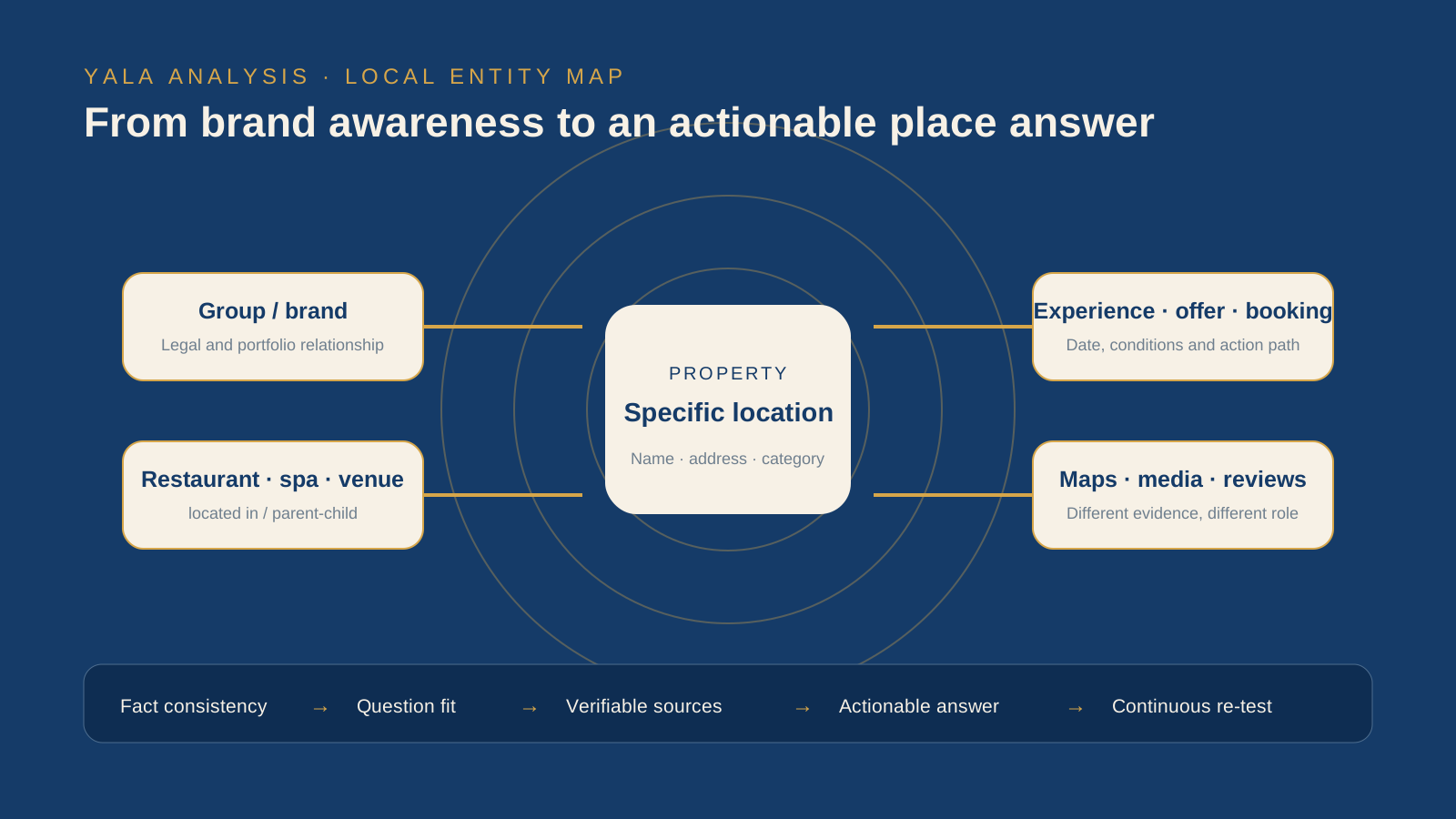
Why can a strong group brand still disappear from location-level answers?
Because the customer is asking a location-level question while the group homepage answers a brand-level question.
A query such as ‘a family-friendly beachfront hotel in Dubai’, ‘a hotel near a landmark with a women-only facility’, or ‘a marina restaurant that can be booked directly’ requires an answer system to combine location, facilities, audience fit, operating status, contact details and a booking path. Group-level brand equity can provide trust context, but it cannot supply every property fact automatically.
The challenge is not simply to create more pages. Each real-world object needs a stable identity. A hotel, an in-hotel restaurant, a spa, a marina, a time-limited offer and a long-term brand asset should remain distinct; otherwise a system may attach a facility to the wrong place, cite an expired offer or treat a group-wide claim as a property-level fact.
What entity hierarchy does a local-service business need?
Google’s LocalBusiness guidance recommends using the most specific business type available for a physical location and keeping address, telephone and opening-hour information consistent with the page. Hotel Business Profiles also require a verifiable management relationship. Machine-readable markup and a verifiable real-world entity must therefore work together.
| Entity layer | Facts that should remain stable | Common failure |
|---|---|---|
| Group / brand | Legal entity, brand name, portfolio and official domain | Applying a group-wide capability to every location |
| Property / location | Name, address, coordinates, phone, category and operating status | Different names or addresses across platforms |
| Venue within a property | Restaurant, spa or club and its located-in relationship | Mistaken for a separate hotel or mapped to the wrong place |
| Product / experience | Audience, dates, inclusions, price and booking conditions | Expired experiences continuing to appear in answers |
| Evidence source | Official site, maps, booking, regulation and third-party reviews | Treating reviews, brand claims and official facts as equivalent |
Public case: what does the information structure of Jumeirah Marsa Al Arab show?
Jumeirah separates the group portfolio from the individual Jumeirah Marsa Al Arab property. The property experience is then organised into accommodation, dining, wellbeing, experiences and offers, with an address, telephone number and booking paths. Its media hub adds citable context about the opening, architecture, rooms, dining and marina.
Jumeirah’s public media material describes a resort made up of rooms and suites, serviced residences, dining, wellbeing and an 82-berth marina. For an answer system, this is not one block of brand copy. It is a set of related facts that must connect to the same property without collapsing into one another.
What should the official site, maps, reviews and media each prove?
A scientific local GEO programme does not compress every source into one score. The official site carries first-party facts, maps carry place discovery and management status, booking platforms provide transaction context, reviews reveal experience signals, and media provide externally verifiable narratives. When these sources agree, answers have a stronger factual base. When they conflict, the first task is to repair the facts, not publish more content.
| Source | Best used to support | Cannot prove on its own |
|---|---|---|
| Company website | Official name, address, facilities, contact and booking conditions | Experience quality or market preference |
| Google Business Profile / Maps | Location existence, category, management information and customer action paths | Every brand claim is accurate |
| Booking platform | Availability, displayed prices, policies and platform reviews | Complete commercial performance across channels |
| Travel and trade media | Openings, design, awards and third-party reporting | Consistent service quality or conversion |
| Customer reviews | Recurring questions, experience differences and customer language | The view of every customer or the whole market |
A six-step GEO workflow for hotels and local services
01 Build the entity inventory
List the group, brands, properties, stores, internal venues, services, experiences and offers. Assign a unique name and owner to every object.
02 Reconcile core facts
Check names, addresses, telephone numbers, coordinates, categories, operating status and language versions across the site, maps, directories and booking paths.
03 Build location fact pages
Give every important place an independently understandable page covering facilities, audience fit, access, contact, booking and last update.
04 Express entity relationships
Use clear navigation, breadcrumbs, internal links and appropriate structured data to connect the group, property and in-property venues.
05 Build the question set
Test discovery, comparison, suitability, price, facility and booking questions by city, scenario, audience and language.
06 Record and re-test
Keep the full answer, citations, factual errors and source changes, then route each repair to a named owner.
How should facts, YALA analysis, hypotheses and forecasts be separated?
| Status | Example in this article | How it should be used |
|---|---|---|
| Public fact | Property address, facilities and information structure on Jumeirah’s official pages | Can be checked against the linked source |
| YALA analysis | A location entity should be the operating unit of local GEO | A methodological judgment derived from public evidence |
| Hypothesis to test | Better fact consistency may improve the stability of relevant location answers | Requires a fixed question set and repeated sampling |
| Forecast | AI assistants may connect maps, booking and transaction actions more directly | A directional view, not a current product fact |
Do not measure only whether the brand was mentioned
Brand mention rate still matters, but for a local service it only shows that the brand is known. Commercial usefulness depends on whether the answer identifies the right place, provides a relevant reason and leads the customer to an executable next step.
- Location accuracy: are the property or venue name, address and relationships correct?
- Task coverage: do family, business, dining, wellbeing, transport and booking questions receive usable answers?
- Source quality: does the answer cite the official site, maps, a platform, media or an unattributed republication?
- Actionability: can the customer reach the correct property page, contact point or booking path?
- Cross-language consistency: do English, Arabic and other priority languages carry the same core facts?
- Freshness risk: are openings, hours, offers and facility changes updated in time?
Further clarification.
Does every location need its own page?+
When a location has its own address, operating information, services or transaction path, an independently crawlable fact page is usually appropriate. The page needs real differences; changing only the city name is not enough.
Is maintaining Google Maps enough?+
No. Maps are important for place discovery, but the brand still needs a controlled, citable and maintainable first-party fact source on its own site.
Will LocalBusiness schema improve AI recommendations?+
There is no guarantee. Structured data helps express page facts; recommendation also depends on content quality, real-world consistency, third-party evidence, query fit and each model’s mechanisms.
Public sources used in this article
- Jumeirah Marsa Al ArabJumeirah · Accessed 2026-08-21 ↗
- A Journey Through Jumeirah Marsa Al ArabJumeirah Media Hub · Accessed 2026-08-20 ↗
- Local Business structured dataGoogle Search Central · Accessed 2026-08-21 ↗
- Get started with a hotel Business ProfileGoogle Business Profile Help · Accessed 2026-08-21 ↗
Sources support public facts, case imagery and methodological boundaries. YALA analysis, hypotheses and operating judgments are identified separately in the article.
YALA developed this research from public sources and its regional operating framework. AI assisted source organisation, structural checks and drafting; Jia Guo completed the final editorial review. To report a factual error or add evidence, contact hello@yalayala.ae.